
Share This Post
Choosing the right watch winder settings should not feel like guesswork. Whether you just bought your first automatic watch, are confused by watch winder TPD, or worry a winder might damage your movement, this guide gives clear, safe answers.
You will see quick, default automatic watch-winder settings, simple brand‑based tables, and step‑by‑step tests so you can keep your watches ready to wear without stress.
Quick Start: Safe Watch Winder Settings
If you just want to know “how to set a watch winder” or “what should I set my winder to right now?”, start here. This section provides fast, safe watch-winder rotation settings you can use today.
Default Settings Most Automatic Watches Can Use
For most modern automatic watches, a good starting point is 650 TPD (turns per day) in a bidirectional program. This is a gentle, safe 650 TPD watch winder setting.
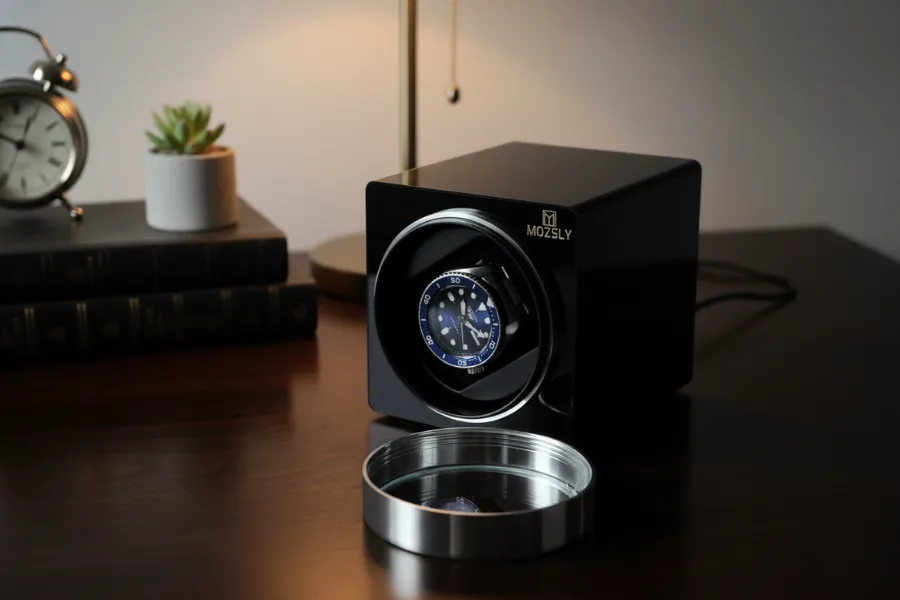
If you cannot find exact specs for your movement, do not panic. About 85% of everyday automatic watches will stay fully wound and healthy with this moderate, two‑way setting.
Use these simple starting points:
- Most modern automatic watches
- Start at 650 TPD, bidirectional
- Works for many basic three‑hand and date models
- ETA / Sellita movements (common Swiss calibers)
- Start around 800–900 TPD, bidirectional
- Suits many watches using ETA 2824, 2836, 2892, or similar Sellita equivalents
- When you are unsure
- Begin at 650 TPD, bidirectional
- Run a simple 48‑hour test
- If the watch stops or shows poor power reserve, increase TPD in small steps
- General rule
- Do not jump straight to the highest watch winder 900 TPD setting
- Make small adjustments and watch how the movement responds.
If you want a deeper breakdown of how long and how often to run your winder, read how long and how often.
Brand‑Based Watch Winder Settings at a Glance
Different movements respond differently to constant winding. Checking brand-specific watch winder settings is always the safest place to start.
Use this table as a quick, “good‑enough” rough guide:
|
Brand (typical automatics)
|
Starting TPD (approx.)
|
Direction to try first
|
|
650–800
|
Bidirectional
|
|
|
650–800
|
Mostly clockwise or bi
|
|
|
Omega watch winder settings
|
650–800
|
Bidirectional
|
|
800–900
|
Bidirectional
|
|
|
Longines (ETA‑based)
|
800–900
|
Bidirectional
|
|
TAG Heuer (Cal. 5 / ETA)
|
800–900
|
Bidirectional
|
These are starting points only. Always refine once you know the exact movement or after a 48‑hour test.
When You Must Check Exact Specs First
Most everyday automatics are forgiving. But some high‑end pieces, like Audemars Piguet watch winder settings or Patek Philippe watch winder settings, are not.
Always look up your model or its movement caliber first if you are dealing with:
- Perpetual calendars
- Annual calendars
- Minute repeaters or chiming watches
- Tourbillons
- Very rare or vintage pieces with unknown service history
For these complex watches, consult the manufacturer’s technical sheet or an authorized watchmaker before you place them on a winder.
You can also read Are Watch Winders Safe? for general safety tips. If you cannot confirm exact specs, it is safer to wind by hand and set the watch when you wear it.
Quick summary:
- Use 650 TPD bidirectional as the default automatic setting.
- Use brand‑based tables as starting points.
- For rare or complicated pieces, always check specs or hand‑wind.
How Watch Winder Settings Work (TPD & Direction)
You have seen some numbers. Now it helps to know what each watch winder setting really does.
What Watch Winder TPD Really Means
TPD (turns per day) is the total number of full rotations the winder makes in 24 hours. If a watch needs 650 TPD, the winder will turn it enough times to reach about 650 full turns each day.
The winder does not spin at that speed all at once. It breaks the total into short runs, then rests. The goal is to copy your wrist movement with small, gentle pushes so the mainspring stays wound.
More TPD is not always better. The low end of a safe range is usually enough.
Rotation Direction and Watch Winder Rotation Settings
Most winders let you choose three common watch winder rotation settings:
- Clockwise
- Counterclockwise
- Both directions (bidirectional)
Most modern automatic movements wind in both directions. Some, however, wind in only one direction.
If your movement only winds one way and the winder turns mainly the other way, the watch will not gain much power.
Matching the correct direction helps you reach full power with fewer turns. For more details, see the direction of a watch winder.
Winding Cycles and Why Winders Pause
Watch winders operate in short cycles to reach the target TPD without stress.
A typical cycle:
- Turn for 30 seconds to 2 minutes
- Rest for several minutes
- Repeat until the daily TPD goal is reached.
This start‑stop pattern is normal and healthy. It copies how a watch moves on your wrist.
Quick summary:
- Watch winder TPD is the total daily turns in many short cycles.
- Direction matters because some movements wind only one way.
- Start–stop cycles are normal by design.
Find the Right Watch Winder Settings for Your Watch
Now that you understand TPD and direction, you can find safe watch winder settings for Rolex, Seiko, Omega, and many others.
Step‑by‑Step: Look Up Your Movement Data
You only need the brand, model, and movement caliber number.
- Check the case back and dial.
- Read the owner’s manual or download it from the brand site.
- Search the brand’s support page for technical data.
- If TPD is not listed, search “[brand] [caliber] watch winder settings.”
- Record brand, model, movement, TPD range, and direction.
Safe Watch Winder Settings by Brand and Caliber
These common ranges are good starting points:
|
Brand / Movement group
|
Safe TPD range
|
Usual direction
|
|
Rolex automatic watch winder settings (31xx, 32xx)
|
650–800
|
Bidirectional
|
|
Tudor watch winder settings (MT‑series)
|
650–800
|
Bidirectional
|
|
Omega watch winder settings (Co‑Axial 8500, 8900)
|
650–800
|
Bidirectional
|
|
ETA / Sellita 28xx family
|
800–900
|
Bidirectional
|
|
IWC watch winder settings (Pellaton system)
|
650–800
|
Clockwise
|
|
Breitling watch winder settings (B01 / B04)
|
650–800
|
Clockwise or both
|
|
Seiko watch winder setting (6R / 4R / 7S)
|
650–900
|
Usually bidirectional
|
|
Grand Seiko 9S automatics
|
650–800
|
Bidirectional
|
|
Tissot watch winder setting (Powermatic 80)
|
650–800
|
Bidirectional
|
|
Jaeger‑LeCoultre automatics
|
650–900
|
Bidirectional
|
|
Zenith El Primero
|
650–900
|
Bidirectional
|
Start at the low end of each range and test for 48 hours.
Special Cases: Vintage and Complicated Watches
Some watches are picky, such as Cartier watch winder settings, Panerai watch winder settings, and very old or complex pieces.
For these:
- Use the lowest TPD that keeps the watch running.
- Prefer bidirectional or the brand’s recommended direction.
- Test in shorter windows, such as 24 hours.
Quick summary:
- Always check the brand and caliber before guessing settings.
- Use brand tables as starting points and test.
- Treat vintage and complicated watches with extra care and lower TPD.
Test and Fine‑Tune Your Watch Winder Settings
Once you have a starting TPD and direction, fine‑tune for each watch.
Conservative 48‑Hour Testing Method
- Fully wind the watch by hand and set the time and date.
- Set a safe starting program, such as 650 TPD, bidirectional.
- Put the watch on the winder and start it.
- Leave it for 48 hours without wearing it.
- Check if the watch is still running and roughly on time.
- If needed, raise or lower TPD in small steps and test again.
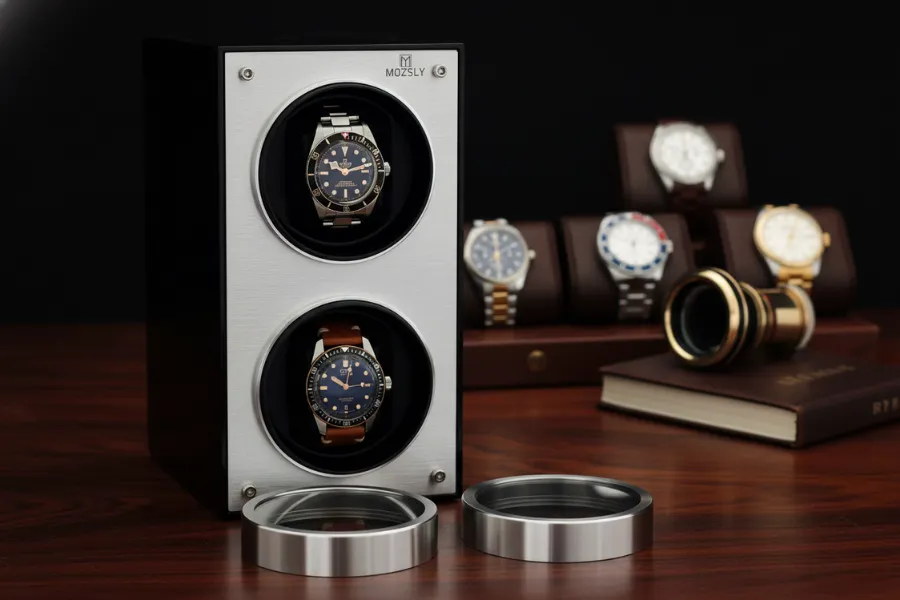
If your device allows profiles, save your best Wolf watch winder settings, Mozsly watch winder settings, or JQUEEN watch winder TPD per watch.
How to Test Different Rotation Directions
- Start with bidirectional.
- If the watch does not stay wound, test clockwise for 24 hours, then counterclockwise.
- Keep TPD the same while you change direction.
- Choose the direction that keeps the watch running and on time.
Troubleshooting When a Watch Is Still Picky
If a watch still acts up:
- Check the fit on the winder cushion.
- Lower TPD slightly and retest.
- Try a program with longer rest times.
- Fully wind the watch and test it off the winder.
- If problems continue, the watch likely needs service.
Quick summary:
- Use one 48‑hour test to confirm TPD and direction.
- Test directions in 24‑hour blocks if needed.
- If problems stay, think about fit and service, not just TPD.
Warning Signs Your Watch Winder Settings Are Wrong
Problems usually fall into three groups:
- The watch stops
- The watch runs fast or slow
- TPD is too high
Watch Stops on the Winder: Key Checks
- Check basics: full wind, reasonable TPD, program running.
- Check fit and position on the cushion.
- Raise TPD in small steps and test different directions.
- If it still stops, suspect a watch movement issue.
Watch Runs Fast or Slow on the Winder
- Measure wrist drift over 48 hours.
- Measure again over 48 hours on the winder.
- If it is worse on the winder, lower TPD, or use longer rest times.
- Check the service history if the drift is bad on or off the winder.
Too Much TPD and Long‑Term Wear Risks
Signs TPD is too high:
- The watch is always fully wound, even at low TPD
- The rotor spins almost constantly
- The watch feels warm after long sessions.
Safer habits:
- Stay near the low end of the range.
- Avoid maximum TPD unless truly needed.
- Give older watches breaks from the winder.
Quick summary:
- Stopping, fast running, or warmth can all point to wrong settings.
- Compare on‑wrist vs on‑winder performance before changing programs.
- Very high TPD is rarely useful and can speed up wear.
Safety: Can a Watch Winder Damage Your Watch?
A winder is generally safe if:
- TPD is moderate
- Direction is correct
- The watch is serviced on time.
Are Watch Winders Bad for Automatic Watches?
Problems usually appear only when TPD is extreme, direction is wrong, or service is overdue. For more details on common myths, see common misconceptions about watch winders.
How Much TPD Is Too Much for a Watch
Most Swiss and Japanese movements are happy around 600–800 TPD. For example, many Rolex watch winder settings work well at 650–800 TPD in bidirectional mode.
To stay safe:
- Start at 650 TPD, bidirectional.
- Test for 48 hours.
- Increase only if the watch stops early.
Magnetization, Noise, and Other Hidden Risks
- Keep the winder away from big speakers, amplifiers, and computer towers.
- Stop using any winder that makes harsh grinding or clicking sounds.
Quick summary:
- A winder used with moderate TPD and a serviced watch is safe.
- You rarely need maximum TPD.
- Avoid magnets and noisy, rough units.
Daily Use: How to Use a Watch Winder Day to Day
Here we answer questions like “how to use a watch winder” and “should I use a watch winder for my Rolex?”
Should a Watch Winder Run All the Time?
Winders are built to run in cycles all day, but constant use is optional.
- “On” does not mean spinning all the time.
- Your watch only needs enough TPD to stay above the bottom of its power reserve.
- Leaving a watch on a winder full‑time is a personal choice.
For more details, see Keep a watch winder on.
How Long Can You Leave a Watch on a Winder
|
Time on winder
|
What it’s good for
|
What to watch for
|
|---|---|---|
|
1–3 days
|
Short trips, weekends, quick rotations
|
Little concern if TPD and direction are right
|
|
1–4 weeks
|
Normal rotation in a small collection
|
Make sure the watch is within service schedule
|
|
Several months
|
Long‑term storage for a few key watches
|
Check accuracy and power reserve sometimes
|
If you leave a watch on a winder for weeks or months, use conservative TPD and check it now and then.
When You Don’t Need a Watch Winder At All
- Simple three‑hand automatics worn daily do not need a winder.
- If you enjoy winding and setting, a winder is only a convenience.
- Quartz watches never need a winder.
Quick summary:
- Decide whether to keep your winder on all the time or use it only when needed.
- Most healthy automatics can stay on a winder for days or weeks with sensible settings.
- Use a winder only if it makes your routine easier.
Related Post's
Featured Video

Provide an email subscription feature for users to sign up for updates.
Follow the world of watches and cigars for exclusive content!
By subscribing to our newsletter, you will be the first to receive notifications of our latest articles, popular posts and special events.


